About Us.
We are a coordinated, community-centred coalition working together to achieve digital equity in Aotearoa.
The catalyst for DECA came out of NZ’s first COVID lockdown in 2020 when the scale of digital exclusion was starkly revealed and the necessity of digital inclusion was put beyond doubt.
That same year, people and organisations from across the digital inclusion community contributed to the Internet NZ-led plan for digital inclusion, called The five point plan for digital inclusion: COVID-19 and beyond.
During the development of the Five Point Plan, the community expressed a desire to be better connected, and for greater coordination.
A small group of people, which we called the DECA Establishment Group, came together to figure out how to connect and coordinate the digital inclusion community in Aotearoa.

Over a year and a half, the Group developed an initiative to achieve this vision, using an inclusive, consultative and community centred process. This included many conversations with those working at the frontline of digital inclusion, and a series of hui with the wider digital inclusion community. In October 2021, the Establishment Group handed over to our Stewardship Group and DECA was officially launched.
Since 2021 DECA has focused on connecting the digital inclusion community to foster collaboration and share resources. We have formed partnerships, hosted hui, delivered research and supported those addressing digital inequities.
Our Structure.
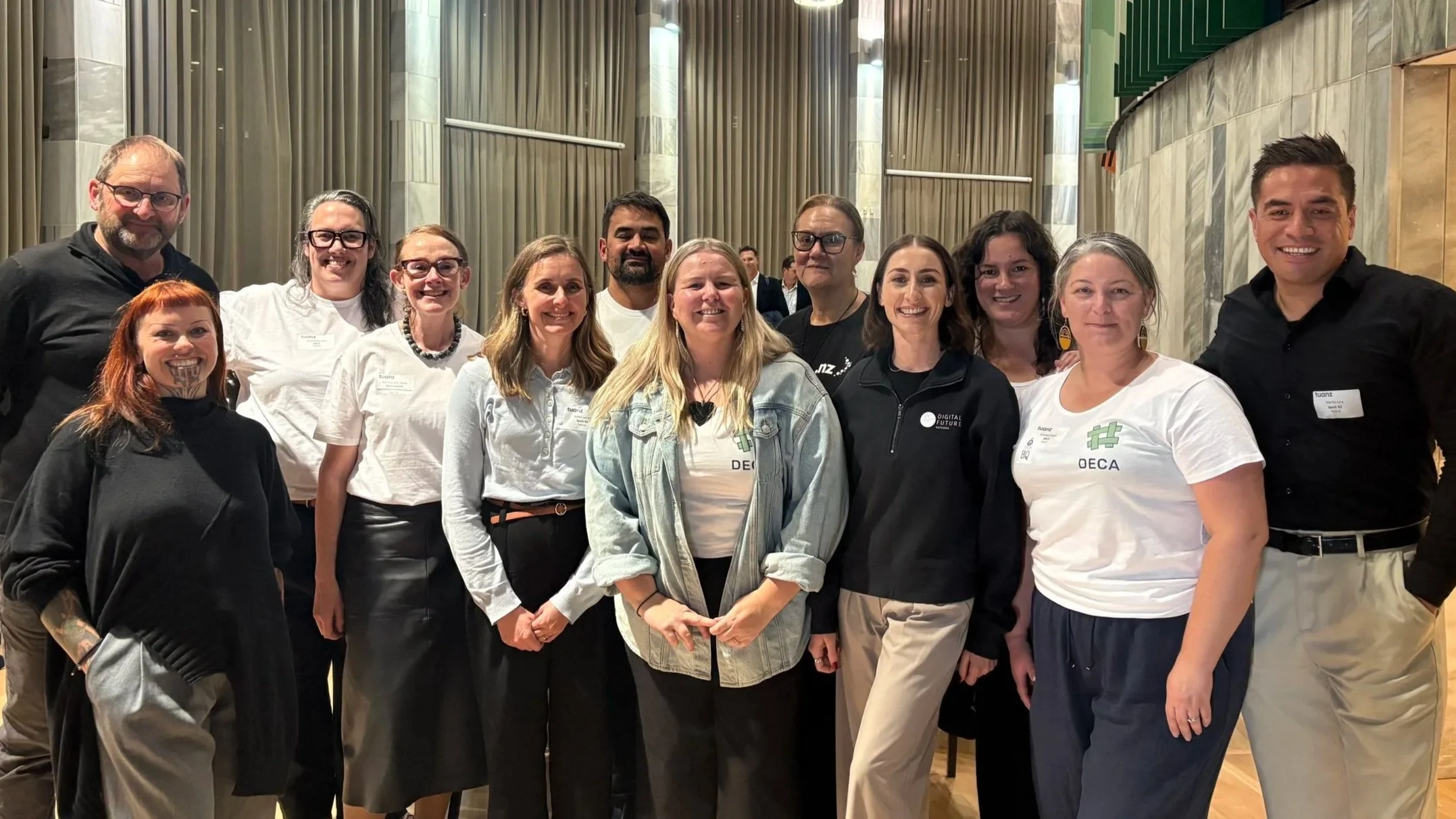
DECA operates as a network-driven community. At the heart of this network is the Te Ohu Whakatere / Stewardship Group, made up of representatives from across the digital inclusion ecosystem. This group provides guidance and strategic direction, supported by our Te Takere / Operations Team who help coordinate the network and amplify the voices of the community.
Our strength lies in the connections and collaborations between people and organisations within our network. We facilitate knowledge-sharing, joint action and mutual support.
Our Strategic Priorities
-
Connection & Communication
We’re keeping the digital inclusion community connected and informed. That means hosting hui, sharing updates through our pānui and online spaces and making sure good mahi and insights are visible across Aotearoa.
-
Advocacy
We’re working with partners to influence policy and investment so everyone in Aotearoa can afford and trust digital tools and services. Our focus is on equity, affordability and community voice in national decisions.
-
Powering the Community
We’re backing the people and organisations doing the mahi on the ground. That includes sharing resources, building skills and supporting collaboration across regions and sectors.


Glossary of Terms
-
The base unit of information in computing. It is also the base unit of measuring network speeds. A single piece of information is equal to 1 bit. Network speeds tend to be measured by bits per second — using kilo (1,000), mega (1,000,000), and giga (1,000,000,000). A bit is a part of byte; they are not synonyms. Bit is generally abbreviated with a lowercase b.
-
The maximum amount of data transmitted over an internet connection in a given amount of time. Bandwidth is often mistaken for internet speed when it's actually the volume of information that can be sent over a connection in a measured amount of time – calculated in megabits per second (Mbps).
-
Broadband is a high-speed internet connection that allows users to access the internet and online services faster than dial-up. Broadband speeds can vary depending on the technology and service level.
-
The digital divide is the gap between those who have access to technology, the internet and digital literacy training and those who do not. It affects all generations – both rural and urban communities – and a wide variety of industries and sectors.
As opportunities created by the internet increase, so do inequities for those who do not have access to the technologies, tools and skills needed to participate in the increasingly digital world.
-
Digital equity is achieved when every person and community has the necessary information technology resources to participate in society, democracy, and the economy fully. The term encompasses not only access to devices and the Internet, but also the ability to use and benefit from them effectively. Digital equity is our ultimate goal.
-
Digital inclusion refers to the initiatives and actions we undertake as we work towards digital equity. Digital inclusion is the means to achieve the goal, Digital Equity.
-
Fibre broadband uses fibre-optic cables to quickly connect the internet from the exchange to your home or business. This is much faster than copper cables, carrying data over large distances at the speed of light.
-
The Internet is not like a telephone network. The global Internet consists of tens of thousands of interconnected networks run by service providers, individual companies, universities and governments. In most countries, a telephone network is run by a single company for several years at a time. Open standards are what enable this network of Internet networks to communicate. And they’re what make it possible for anyone to create content, offer services, and sell products without requiring permission from a central authority.
-
Since mobiles became a thing, the technology that supports them has constantly evolved. The ‘G’ in 3G, 4G and 5G stands for ‘generation’ – that is, they’re the third, fourth and fifth generations of mobile technology. The 2G and 3G services will be switched off in Aotearoa New Zealand on the 31st of December 2025.
Each generation brought us something slightly new:
2G let us send SMS and MMS text messages.
3G brought us mobile internet.
4G improved on 3G's mobile broadband speeds, making things like video streaming possible.
5G offers faster speeds and lower latency, with more compatible devices able to use it simultaneously without slowing down the network.