
Why we love Kevin - A No Tech Day Pānui
It's No Tech Day today.
Did you know 90.44% of passport applications were submitted electronically last year?
Our government is very pleased about this.
What the statistic doesn't show is Kevin.
Kevin Bicknell opens the doors of Smart Newtown every weekday morning and welcomes people into a quiet computer nook upstairs at the Community Centre in Newtown, Wellington.
People rush in to see Kevin. People who don't have the internet at home. People who are completely disillusioned with computing. People like the elderly gentleman with a $600 phone bill he didn't understand and couldn't fix on his own. People who have had a whānau member pass away overseas and need a passport but don’t know how to use a scanner.
We won’t find them in any government success statistic.
Over the last decade, managing a bank account, applying for citizenship, enrolling to study, managing student loans, applying for jobs, renewing a passport, enrolling to vote, qualifying for a learners driving license, nearly all the essential parts of Kiwi life have quietly drifted online. The government calls this progress. And in many ways it is. But this progress has a shadow.
The hundreds of thousands of New Zealand households who are at risk of being left behind by it.
The people holding the line between a big chunk of New Zealanders and digital exclusion are largely invisible, unless you need their help. People like Kevin, who runs free computer classes, distributes Skinny Jump modems, helps people sign up to the Equity Fibre 100 product while offering a free tech support help-desk to anyone who walks in, with his assistant Andy and a strong volunteer team, without whom, as Kevin puts it, "the scope of our work would be greatly reduced."
Smart Newtown nearly closed this year. Wellington City Council pulled its funding. The digital inclusion ecosystem rallied and kept it open. Kia ora Nat at Chorus, Kia ora Ciara at Internet NZ, Kia ora Anna Symons Poussaiou at Newtown Community Centre, thanks for working with us to keep Kevin at his desk.
Real talk though, that shouldn't have ever needed to happen. The lack of support for Smart Newtown isn't an accident. It's a policy choice.
The Tasmanian Government's Digital Tasmania 2026-2031 strategy names libraries, councils and community hubs as key enablers of digital skills and access, and commits government to a partner role. The United Kingdom's Digital Inclusion Action Plan, published February 2025, went further. Four areas of work: skills, device poverty, barriers to digital services, confidence. A dedicated funding stream. An external accountability body. And from June 2026, every new UK government digital service has to meet inclusive service standards before it goes public.
Two different ways Digital Inclusion has been built into the definition of working government services. Seems like a no-brainer considering NZIER research estimates every dollar invested in digital inclusion returns two?!
In 2019, the New Zealand Government published a Digital Inclusion Blueprint. In 2022, a Digital Strategy for Aotearoa named a government Digital Inclusion Lead and a national digital skills framework as work underway. By March 2023, six months later, DIA had concluded its digital inclusion programme.
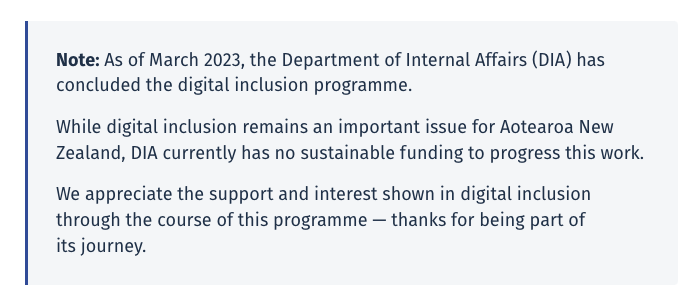
Screenshot taken from digital.govt.nz today, Friday 28th August 2026.
However, government services have kept shifting toward digital anyway and more recently, at a significant pace.
When the Hon Paul Goldsmith, Minister for Digitising Government was asked directly at the TUANZ Connecting Aotearoa Summit in May this year about digital inclusion, he said:
On device support and access: "That's the role of the providers of those devices, the companies who are out there."
On trust in digital systems: "People who've got the greatest interest in maintaining trust are the providers of services out there providing them."
On digital skills, after noting the education system gives people a grounding: "and then we leave them to it."
And then we leave them to it.
So who picks them up? Kevin does.
And Leala at Libraries Horowhenua. And Riley at Recycle A Device, who watched a young mother cry after finishing work on a laptop she could finally take home, because she'd been using her daughter's school laptop to job hunt. And Nina at Tagata Moana Trust, who strongly believes digital equity is about who gets to participate in the future and who gets to shape it. And Whaea Keziah at Whangamarino School who has built an entire technology programme (Piki Kouras) to provide local tamariki access to robotics through connection to taiao. And it's not just them of course. The Citizens Advice Bureau does it. Budgeting services do it. Churches, health services, community law centres. Whānau (kia ora to our rangatahi) and Iwi are right there too.
Yet again, our government's own Kiwis Count survey found people using exclusively digital channels to access government services reported higher satisfaction. This, just like the digital passport application success, gets used to justify further investment in digitising services. What it doesn't ask is who got those people to exclusively digital use in the first place.
The labour of Digital Inclusion doesn't appear anywhere in any government survey and it does not receive the investment it justifies.
No Tech Day exists to make that work visible. And this year, every dollar raised from our t-shirt fundraiser goes directly back to the community organisations doing it.
Because someone has to. And right now, that someone is Kevin.
Head to www.notechday.nz to read about Kevin and all our Digital Champions for 2026 and if you’ve shared any of the No Tech Day social media stuff, you’re a champ too. It’s here on Instagram and here on Facebook.