
Affordable Connectivity in Aotearoa:
Report on DECA mahi on the affordable connectivity problem and options to address it.
Summary
Digital Equity Coalition Aotearoa (DECA) is concerned that many New Zealand households cannot afford internet access (at home and when out and about). We refer to this as the “affordable connectivity” problem. DECA members working in communities report that the problem has got worse with the cost of living crisis.
DECA has been advocating for government support to help low income households get the essential internet access they need to function and thrive in an increasingly digital world. Government policy decisions have in part been hindered by concerns that there is not enough information on the scale of the problem, who is most in need of support, how much internet access they need, and how support could be provided. DECA set out to fill the gap with this mahi on the affordable connectivity problem and options to address it.
-
We started by asking people in the community what they need to participate in the digital world in a meaningful or mana enhancing way. From this community engagement we have determined that the following is needed:
an appropriate device
an uncapped internet connection
the skills necessary to function in the new digital world
The next step was to determine the cost of this, and compare the cost to what people told us they could afford to pay, and the international benchmark that says connectivity should not cost more than two percent of income[1]. We found that that:
The cost of a minimum appropriate digital enablement package currently is between $27.12 to $54.37 per week, depending on the number of children and adults in a household. We based the rest of our calculations on the $43 per week cost for a two parent two child family (two devices for the children).
Based on our engagement with whānau, the average amount households can afford to pay per week is $7 for internet and $5 for a device per week. This equates to $17 per week for internet and two devices for a two adult two child family.
Based on the two percent of income threshold, households in the lowest income quintile (earning less than $42 200 per annum) can afford to pay between $0 and $16 per week ($8 on average) for internet access.
The shortfall between the cost ($43) and what households can afford ($17) is $26. This is the amount that needs to be subsidised per household per week for internet plus device access.
If the focus is just on internet access (without devices) the subsidy amount would be $4.54 per week.
-
We then considered the question of how many households can’t afford digital access and are in need of support. We found, based on a two percent of income benchmark, that none of the 380 000 households in the lowest income quintile (income under $42 200) could afford the package of meaningful digital access.
Taking the total number of households in the lowest income quintile (380 000) and multiplying it by the shortfall between cost and what they can afford ($26 per week) we calculate that it would cost approximately 514 million per year to help all households in the lowest income quintile to have affordable access to internet and a device needed to use it.
We appreciate it would be a significant financial commitment to help all 380 000 households. We therefore recommend that the Government start by focusing on the 58 000 families in this quintile with children. The total cost of subsidising digital access (internet plus devices) for these households would be $1 352 per household per year totaling $78,416,000 per year for all 58 000 households. If you just focused on internet access (not devices) the cost would be $236 per household per year - a total of $13.88 million for all 58 000 households.
While there will be smaller households (single persons and couples) in the lowest income quintile who will struggle to afford digital access, families on similar incomes will be facing additional hardship, which is why we suggest you start with this cohort.
-
The next step was to look at options for subsidising internet access. We looked at options through the welfare system, administered by other agencies or NGOs, specifically designed equity products, and subsidies connected to social housing. Our recommended option is a digital equity payment, similar to the Winter Energy Payment, administered by the Ministry of Social Development (MSD), that can be put towards the cost of home and mobile internet access. This option could also sit alongside a contribution from the telecommunications sector in the form of discounted internet services for households who qualify for the subsidy. Eligibility would be connected to income level, and would be determined by MSD.
We then considered how the Government could fund the subsidy. Options include a new appropriation, re-directing funds from the Telecommunications Development Levy (TDL), increasing the TDL (if telcos were not contributing in other ways), contributions from agencies doing digital transformation projects that move services online, and a social investment agency funded by government that also seeks contributions and investments from the private sector.
Because internet access is not enough on its own (digital skills, access to a computer and wrap around support are also needed), we also considered how the Government could support community organisations offering digital skills programmes, recycling laptops and other devices, and providing wrap-around support to get people online and support them as they get started. We have recommended that these services be funded through an NGO intermediary, using a model similar to that used by the Good Things Foundation (in Australia). Community hubs (libraries and others) also need to be funded (jointly by central and local government) to provide last resort support to people struggling to access essential services online. Demand for these community based services has increased dramatically as a result of government moving more services online, and as banks and telecommunications retailers close their store fronts.
-
Lastly, we considered the issue of measurement and evaluation. It is essential that the Government is able to measure the impact its interventions and investments are having. We recommend the introduction of an index similar to the Australian Digital Inclusion Index, which measures access, affordability and digital ability.
DECA recommendations at a glance:
Introduce a digital equity payment, similar to the Winter Energy Payment, with an initial focus on the 58 000 families earning less than $42 200 per year
Fund community organisations offering digital skills programmes, devices and wrap around support, through an NGO intermediary
Partner with local government to fund community hubs to provide last resort support to people struggling to access essential services online
Introduce a digital inclusion index so we can measure progress.
Part one: an introduction to our affordable connectivity mahi
DECA has been doing research and supporting other work to better understand:
What whānau/households need to be able to meaningfully participate digitally in society. In other words, what is the minimum needed to participate in a meaningful, mana enhancing and dignified way? The primary focus of this work has been on affordable connectivity (internet access).
The market cost for the above
What is affordable for New Zealanders on lower incomes, in terms of weekly or monthly spend, and as a percentage of household income
How many households can and can’t afford the package of meaningful digital access that has been identified
-
The answers to the above questions have been used to inform the advice in this paper on solutions to address the affordable connectivity and related digital equity issues. DECA has suggested solutions to government before - in this paper we go into the solutions and questions about them in more detail.
We are providing this analysis to help ministers make decisions on how the Government can best intervene to get Aotearoa on the road to digital equity. We are conscious there has been some reluctance or delay due to not having an agreed view on the size of the problem, and unanswered questions on how to target interventions. We hope to fill those gaps with this advice.
The solutions and questions we canvas in this paper include:
Options for a digital equity subsidy from government for affordable connectivity and for devices. The options range from a digital equity payment from MSD (similar to a winter energy payment), better using existing MSD payments to cover internet and device access, device access through the education system, and a subsidised co-designed equity product or products for internet access. We also cover related questions such as who in government is best placed to develop and administer the suggested approaches, and international precedents.
The concept of bulk funding an NGO intermediary to allocate digital equity funding for community programmes. The main focus here is on digital skills, devices and wrap around support. This analysis is provided to help solve the problem of government procurement processes that don’t work for community, and to remove the burden from government of making eligibility decisions when it is not best placed to do so.
Who (in terms of population cohorts) to focus on if there is not enough funding for everyone who can’t afford digital access.
Eligibility criteria - what are they and who decides if someone is eligible.
The advice and analysis has been informed by:
answers to the research questions above - this work included face to face engagement with whānau and analysis of official statistics and other reports
insights of the DECA community
access to research and analysis undertaken by officials
desktop research that has considered approaches in other countries, taken inspiration from approaches used in other parts of New Zealand government, and considered digital equity approaches taken by NGOs in Aotearoa.
Part two: the scope and scale of the affordability problem
DECA is conscious there may not be agreement across government on the scope and scale of the digital equity problem. What people need in terms of internet access and how many households are missing out and need help.
We have engaged with community and taken another look at the official statistics and other data to provide these insights on the affordability side of the problem.
In this section we:
Recap some earlier estimates on the amount of data a household needs to do everyday things on the internet. This includes estimates from DIA, MBIE, MoE, DECA and Chorus.
Share the findings from the Arataki engagement with whānau on what is needed for a mana enhancing package of digital access.
Take the Arataki findings and overlay them with other data about households to provide insights on how many households can’t afford mana enhancing digital access, what those households look like and where they are most likely to be located.
-
Department of Internal Affairs and Ministry of Education
In advice to ministers in 2022 the Department of Internal Affairs (DIA), supported by the Ministry of Education (MoE), suggested there could be different use cases for government support for internet access for people on low incomes. These included:
large families with members learning or working from home
single persons/smaller families with high use
single persons with low use.
DIA and MoE took the use case from the MoE Equitable Digital Access programme to estimate how much data would be needed for the first two groups. The recommendation was a 300 GB or unlimited data package for education use. This was based on the following estimates:
Each student needs 130 GB per month to cover video conferencing, video streaming and access to education content. For two students you need 260 GB.
Plus 60 GB per month for miscellaneous family use (based on a MBIE estimate -see below)
This could get you to 320GB for a household with two adults and two children.
Ministry of Business, Innovation and Employment
The MBIE estimate was 60 GB per person per month (which would be 240 GB per month for a family of four). MBIE’s use case was for:
Each person in a household using video conferencing type services for two hours per day for education, government services and other purposes (they thought video conferencing would be a low use activity for most people)
Assuming that each hour of VC uses approximately 800 MB of data, needing a base speed of 8-10 Mbps
Plus a further 10 GB for other less intensive internet activity.
DECA’s earlier assessment
DECA’s 2022 Affordable Connectivity white paper recommended unlimited data, noting this is the norm for most households. We also noted that the average data used in
the home is increasing rapidly as more everyday activities move online, with more data hungry applications, making data caps unhelpful. -
We asked Chorus how much data is used for everyday activities. Here are some examples, generated using the Chorus data calculator:
-
Using these calculations from the Chorus data calculator we very conservatively estimated monthly internet usage for a fictional four person household (two adults and two secondary school aged children). Under this scenario there is nobody working or learning from home, no gaming, movie downloads or music subscriptions, and very little online television usage. The reality is that most families would easily exceed this. But it shows that even with modest internet usage we are easily in the realm of unlimited data home internet plans.
Even if we take out the modest 1.6 hours of TV streaming per day (which some government folks may consider to be a luxury), the total is 355 GB. This is similar to the DIA and MoE estimates.
Summary of Part Two findings:
Even with relatively modest internet use, a family of four will need an internet plan with unlimited data.
A minimum appropriate digital enablement package of digital access includes: an appropriate device, uncapped internet connection and digital skills training.
The cost of internet and device access for a two parent two child family is $43 per week.
Households in the lowest income quintile (earning less than $42 200) can afford to pay (on average) $8 per week for internet, based on the two percent of income benchmark.
Our face to face engagement found that families could afford (on average) $7 per week for internet access and $5 for device access. This comes to $17 for internet plus two devices for a two parent two child family.
The cost of a subsidy for internet and device access for a two parent two child family would be $26 per week for the household (this is the difference between the $43 cost and the $17 that can be afforded). An internet only subsidy would be $4.54 per week.
The cost of providing an internet and device subsidy to the 58 000 families in this low income group would be $78,416,000 per year. The cost for an internet only option would be $13.88 million.
The cost of providing the subsidy to all 380 000 households with income less than $42 000 would be $513,760,000 per year.
-
We worked with Arataki to better understand, directly from whānau, what they need to engage in the digital world in a meaningful and mana enhancing way. In other words, what is a minimum appropriate digital enablement package? As part of this we wanted to test assumptions that government agencies, researchers and NGOs such as ourselves had been making about what people need to do online, how much internet access a household needs in terms of data, what else they need, and how much they could afford to pay for that.
In seeking to understand what a mana enhancing package looks like we were inspired by international developments. These included:
The concept of “meaningful connectivity” being used by a number of international organisations, including the Broadband Commission and global nonprofits the Alliance for Affordable Internet and the Global Digital Inclusion Partnership. Meaningful connectivity includes an unlimited broadband connection.
The minimum digital living standard developed by the Good Things Foundation in the UK, and being rolled out by the Welsh Government.
-
A team, led by Lee Timutimu (Arataki Systems)[2], and supported by fellow Māori tech leaders Hiria Te Rangi (Whare Hauora) and Amber Craig (Tumu Labs), have explored what an affordable connectivity solution could look like. The intention is to address digital inequity utilising a new delivery and service model that is by Māori, but for all. As we have seen with the Covid vaccination roll-out a Māori led and centred approach will have a significant impact on overcoming some of the real and perceived barriers to getting homes connected, particularly within lower socio-economic communities.
Leveraging their strong relationships into Māori communities, the team were able to engage safely and appropriately with whānau with a high level of trust. This made all the difference in accessing insights and feedback from Māori communities. The team also leveraged its strong networks and relationships into the Māori tech community, and conducted a number of interviews with Māori tech leaders.
Engagement methods employed included in-person hui (meetings) and wānanga (discussion forums) with leaders and community members at flax roots (on the ground) level. Online methods, such as surveys and virtual meetings, were also utilised to enable the wider capture of data from individuals and communities around the country. A combination of in-person and virtual engagement allowed the team to engage with a wider audience which ultimately contributed to the quality of data captured.
People involved in the engagement process included Māori and Pasifika tech leaders, Marae trustees, Māori whānau and the Māori tech community. We also engaged with the general population via online survey mechanisms.
Respondents were asked a range of questions relating to the subject of “affordable internet”. We also polled respondents on some possible pricing scenarios (i.e., what they’d be willing to pay for an affordable internet product), which revealed some interesting insights. The line of questions posed were formulated by the DECA stakeholder collective and were directly informed by the research that has already been done on this subject.
-
The Arataki research confirmed unequivocally that whānau consider an internet connection to be a necessity, with 100 percent of respondents answering “Yes” when posed with the question “Would you say internet access is important to you and your whānau?”
This set the tone for much of the research engagement with whānau and their households. The Arataki team were consistently told by whānau that the internet helps them to stay in touch with their family and friends, both here and abroad. This validated many of our assumptions concerning the importance of an internet connection to whānau and the importance it holds in terms of staying connected with the outside world.
Maintaining connectedness to those outside of your home speaks to the importance of connectivity to your community. We were told by whānau that the use of virtual communication platforms was an important part of maintaining their connectedness, especially with their family members overseas. Other insights included the ability to access services online for information and utilities, the ability to work from home (particularly relevant during the Covid-19 era) and the ability to create economic wealth through entrepreneurship opportunities.
-
A highlight of the engagement mahi involved working with Marae trustees at various marae around the country. The insights they shared were often unfiltered and in some instances hard hitting.
“Land lines are unreliable in this area so, although I am resistant to technology, I have given in to using it to communicate with whānau, to arrange marae bookings etc.”
“With the increased acceptance of internet usage on the marae for various hui, connectivity has allowed those unable to arrive in person (ie. due to māuiui (sickness), overseas, etc.) to still participate.”
Keeps us connected to the rest of the world instantly. Communication with family is cheaper, faster and easier.
As I reside in a rural location, Teams/Zoom via the internet enables me to maintain valuable business networks regionally, nationally and globally.
“Our whānau use it daily to connect to each us connected to the world.”

“It is important because it
helps keep other and the world.”
-
DECA/Arataki found that whānau/households need the following, as a minimum, to engage in the digital world in a mana enhancing way:
an appropriate device
an uncapped internet connection
the skills necessary to function in the new digital world
-
The Arataki engagement work found that whānau can afford to pay an average of $7 per week for the internet and $5 per device as part of the minimum appropriate digital enablement package (a total of $17 for internet plus two devices). This is similar to the international benchmark that anything more than two percent of income is affordable for internet access. Applying that two percent benchmark to the lowest income quintile in New Zealand (incomes under $42 000), FigureNZ found that households in this quintile can afford to pay between $0 and $16 per week ($8 on average) for internet access.
-
We worked with InternetNZ to understand what the internet access and devices aspect of a mana enhancing package of digital access costs. InternetNZ found that the cost of a minimum appropriate digital enablement package is between $27.12 to $54.37 per week dependant on number of children and adults in a household. This is presented below for different household sizes, and includes the cost of home internet, internet while on go, and device cost. The appendix includes further information on device needs for different types of users, and what those devices cost.
For our calculations on the financial support needed to afford the minimum appropriate digital enablement package we use the two parent two child family scenario, of the cost of which is $43 per week.

-
We asked FigureNZ to take the cost of the package of meaningful digital access, and the insights from Arataki on what whānau needed and could afford, and tell us:
how many households could not afford the mana enhancing package
what income ranges they are in
what is affordable in terms of a percentage of household income for those deciles, and how does this compare to the two percent benchmark that is used internationally
which households are most in need of support in terms of demographics and location.
In this section we:
make some preliminary comments about the two percent of income benchmark
outline the FigureNZ approach
share the findings from FigureNZ.
-
The UN Broadband Commission says that internet is affordable when it is priced at two percent or less of average income. Using a national average income does not, however, account for income inequality and differences in family sizes and other demands on the budget. DECA is also of the view that the two percent should include home internet, mobile internet and the cost of devices. For these reasons we asked FigureNZ to look at the data and tell us if two percent was an affordable benchmark for low income New Zealanders.
-
Figure NZ’s analysis used data from the Household Economic Survey (HES). The HES is a regular survey designed to measure the economic well-being of New Zealanders. The ‘income’ module provides robust segmentation of household income levels by demographics and household characteristics. It is run every year.
Household counts and incomes are for the year ended June 2022. These values are likely to be lower than actuals because the population grew by an estimated two percent in the past year and wages also grew. It is also important to note that the data collection for the latest HES was reduced due to COVID-19 alert level restrictions, lockdowns and other disruptions.
The HES provides counts of people and households by household composition. The following groups were considered by FigureNZ for the digital equity mahi:
Couple with one dependent child
Couple with two dependent children
Couple with three or more dependent children
One parent with dependent child(ren).
The FigureNZ calculations are based on the most up to date information on New Zealand income quintiles, provided by StatsNZ through a custom data request. We have not used income deciles because StatsNZ has not updated the decile figures for several years.
Here are the household income quintiles for the year ended June 2022:Quintile A: Less than $42,400 (the lowest-earning 20% of households)
Quintile B: $42,200 to $75,999
Quintile C $76,000 to $116,999
Quintile D $117,000 to $173,999
Quintile E $174,000 and over (the highest-earning 20% of households).
-
The figure below shows the number of households falling below the $42,200 income level, which corresponds to the lowest quintile. This is segmented by household composition and excludes household types that are outside the scope of this package, such as couple-only and people living alone.
This data shows that in 2022 there were around 42,900 low-income households that are couples with at least one dependent child or one parent with at least one dependent child. This number increases to 58,300 when including other types of one- family households with children.
For context, the total number of households as of June 2022 was 1.91 million. There are 382,200 households in the lowest income quintile, the majority of which are people living alone.
FigureNZ calculated whether the digital access packages were affordable at the top income level of the quintile or the middle point of the quintile ($21,100). This is done by applying the industry-standard two percent benchmark as a ratio of digital access cost to annual gross household income.
Two percent of average amount of income for quintile-1 households: $21,100 * 0.02 = $422
Two percent of top amount of income for quintile-1 households: $42,200 * 0.02 =$844
These values are lower than the proposed costs of the packages, which range from $1,410.47 to $2,827.40 per year per household, depending on the number of adults and children.
The table below illustrates the gap between package cost and the amount that a household can afford, based on the two percent benchmark. This is an average per household, segmented by composition type.
-
The household composition classification is different from the way the packages were defined by DECA. FigureNZ therefore applied the cost of the closest match.
FigureNZ identified three shortfall scenarios to illustrate that digital connectivity is unaffordable for all low-income households, regardless of their composition. The scenarios are:
Households pay nothing
Households pay two percent of income - based on the average income in the lowest income quintile
Households pay two percent of income - based on the top income level on the lowest income quintile.
The following table shows the cumulative funding required to cover the shortfall, segmented by household composition. It is calculated by multiplying the number of households by the shortfall amounts.It also demonstrates how widely the gap would change depending on the numbers used.
-
There are two high level intervention options for government to help people access the digital equity essentials: affordable connectivity, devices such as laptops and tablets, digital skills and wrap-around support to get and stay online:
One approach is to subsidise the cost of internet access and devices, for those who can’t afford them.
The other is to fund programmes in community that provide digital skills and wrap around support.
We think a combination of the two approaches is needed. Internet access lends itself to the subsidy approach. Digital skills and wrap around support are in the community funding camp. Device access could be supported by either approach - either subsidising the cost for individuals or funding devices as part of digital skills or device recycling programmes.
Options for both approaches are explored in the remainder of this briefing.
-
There are several subsidy approaches that government could take:
digital equity payment through the welfare system that could be used by people on low incomes to help pay for internet access or for both internet access and devices
digital equity payment administered by another government agency or an NGO
using/amending existing MSD payments to subsidise internet and device costs
subsidising device costs for rangatahi through the education system
government partnering with internet service providers (ISPs) to jointly subsidise the cost of internet access for people experiencing income poverty (through an equity product or products specifically designed to meet the needs of the digitally excluded)
government becoming a retail service provider (RSP) of internet services
subsidising home internet through social housing.
Each option is explored below. We then offer thoughts on how the Government could fund a subsidy. A regulatory option is also presented as an alternative to a subsidy, for comparison purposes.

Summary of Part Four findings:
A digital equity payment, similar to the Winter Energy Payment, is the most straightforward and preferred option.
A subsidy goes further if teamed with low cost internet packages provided by ISPs, available to households that qualify for the subsidy.
Devices for children should be subsidised through the education system.
As an interim measure MSD should add internet and devices to the essentials list for hardship assistance etc.
The Government could fund a payment through a combination of a new appropriation, redirecting funds from the Telecommunications Development Levy, budgeting as part of government digital transformation projects, or through a social investment approach.
Option A: a digital equity payment through the welfare system - for internet access and/or devices
In this section we cover the following:
The degree to which the welfare system already provides support for internet and device costs
Our thinking on how a digital equity payment would work and the pros and cons of the option
A New Zealand precedent for the suggested approach
An international precedent for an internet subsidy through the welfare system.
-
The welfare system (via MSD) currently provides very little support for internet and device costs, despite the Welfare Expert Advisory Group finding that these costs are essential. The support on offer tends to be one off and discretionary with no certainty around eligibility. It includes:
One off hardship assistance (HA): assistance could be provided to pay a one off internet bill. The limitations of HA for internet is that it is for one off assistance (not ongoing support), highly discretionary (because MSD does not consider internet to be essential for hardship purposes), and funds provided through the HA may need to be paid back. It is also difficult to get HA to pay for a BYOD device for school, because neither MSD or MoE say devices are essential. We understand that an upcoming review of the HA may consider changes to cost categories which will provide an opportunity to include internet and devices in the essential category.
Temporary additional support (TAS): a weekly payment that helps when folks don’t have enough money to cover essential living costs. Because internet isn’t considered an essential cost, it is discretionary under TAS. While internet costs will be considered in the review of TAS, this could be some years away.
Training incentive allowance (TIA): internet costs can be paid for single parents in training.
-
We are of the view that a digital equity payment through the welfare system (MSD) - for internet access - is the most straightforward subsidy option. It is also our preferred option for government support with internet access, and the option preferred by DIA officials. MBIE also supports a subsidy approach, in combination with government procurement (discussed below).
-
The benefits of a digital equity payment through the welfare system, compared to other options, are:
It avoids a number of the complications and costs associated with the option of working with industry to jointly design and subsidise a new equity product - complex commercial negotiations with ISPs, and the need to consider regulatory and competition law issues.
It provides choice and flexibility for consumers. It is also likely to be perceived as more mana-enhancing as households can access what is best for their home, instead of something that is perceived as a second class or charity service.
It keeps the process simple for vulnerable New Zealanders, who do not need the burden of a complicated application process.
It is a solution that makes sense when we consider that the underlying problem is an income poverty one.
It utilises the expertise that MSD already has in designing and administering welfare payments.
-
The potential downside of this option (from a government resourcing perspective) is that it would require MSD to reprioritise its work programme to do the policy and design work.
-
Here is our thinking on how a digital equity payment might work:
Recipients of the payment could use it to contribute to the cost of home and mobile internet packages provided by any ISP.
The funds would be paid to the MSD customer (as is done for the Winter Energy Payment). The alternative is to make the payment directly to the ISP chosen by the customer, but that may require more costly and time consuming administration (as is the case for the US and UK approaches considered below). Another variation of this option is a voucher system.
The payment could be just for internet access (at home and on the go) or both internet and devices.
The payment could be teamed with a telco industry contribution where ISPs voluntarily offer lower cost packages (at or below a specified price) for people who receive or are eligible for the MSD digital equity payment. This could enable the subsidy pot to go further and more people to be supported. It would however make design and delivery more complicated than a subsidy on its own, as ISPs would need a process for knowing a potential customer is eligible for or receiving the MSD subsidy (ideally through an API feed into telco systems). There may also be some regulatory issues for MBIE to work through if products are not being made available to all (i.e. those on higher incomes).
An alternative to the idea in (d), proposed by MBIE, is to team the government subsidy with contestable procurement. They call this contestable procurement plus co-payment. Under this option, the Government would issue a tender for a broadband product meeting certain specifications for speed and data capacity, at a specified maximum household cost. Government would pay the subsidy to the ISP who is providing the services to the eligible consumers. This is similar to the US approach discussed below (which is, in our opinion, overly complicated).
To ensure effective uptake, the payment would need to be supplemented by funded wrap-around support in the community, to help those new to the digital world to navigate ISP options and get set up. We recommend that wrap around support be provided by community organisations and funded through an NGO intermediary. The NGO intermediary proposal is discussed later in this paper.
-
The following figures (from Arataki, InternetNZ and Figure NZ work) could be used to help calculate the amount of the payment and the total cost. This is based on the following:
Whānau (with two children) in the lowest income quintile could afford to pay on average $17 per week for internet access and two devices ($7 for internet access and $5 per device).
Whānau need an uncapped internet connection and appropriate devices (discussed earlier) which would cost between $27.12 to $54.37 per week dependant on number of children and adults in a household. For a two parent two child family the cost is $43 per week.
The subsidy is the difference between the amount whānau can afford and the market price. For internet access plus two devices this is $26 per week. For internet only it is $4.54 per week.
The total cost for an internet plus devices subsidy if it was offered to and taken up by all 380 000 households in the lowest income quintile would be $513,760,000 per annum.
If an internet plus devices subsidy was just offered to the 58 000 families in that quintile (the recommended approach) the cost would be $78,416,000. An internet only subsidy would cost $13.88 million per annum for the same
cohort.
-
A digital equity payment through MSD, that is able to be used for any internet service, similar to the Winter Energy payment, is our preferred option. The reason for this is (relative to the options discussed below) its simplicity, ease of administration, and not placing unnecessary complexity and burden on people who are already struggling.
It is also an approach that supports competition in the telecommunications sector. It's fair to big and small providers, and is technology agnostic (enabling both fibre and wireless options, which is important for people who can’t get fibre in their area and for families or children who move often).
Eligibility criteria are discussed in the section on eligibility later in this paper.
-
New Zealand already uses the subsidy approach to help New Zealanders on low incomes afford the cost of heating homes - through the Winter Energy Payment. Eligibility is simple - the payment is automatically paid to people who already get other specified payments from MSD. The Winter Energy Payment rates are $20.46 per week for single people without dependents and $31.82 per week for couples and people with dependents.
The precedent value of the Winter Energy Payment is as follows:
it is an example of government subsidising access to an essential utility for people who can’t afford the essentials
it shows that MSD already has the expertise to design the payment and to administer it
it provides an example of an easy way to work out eligibility - tagging it to eligibility for something else that is income and hardship related.
-
Australia provides quarterly payments, to help with internet costs, to people receiving disability payments.
Option B: use an alternative department or an NGO to develop and administer the subsidy
While MSD is the most logical choice because of its experience developing and administering welfare payments, and because the underlying issue is income poverty, agencies outside the welfare system could do the job if the Government does not want to use MSD.
In this section we canvas the following issues:
The agencies that could develop and administer the payment
How the payment might work
International precedents for a subsidy outside the welfare system.
-
MBIE is a candidate because of its responsibility for digital economy and communications. It is not possible to meet the aims of its statement of intent on Lifting Connectivity in Aotearoa New Zealand, to enable more people to benefit from connectivity, without addressing equity and affordability issues. Having fibre run down your street with the possibility of connecting to it is not internet access. Access is not achieved until affordability and equity is addressed.
The MBIE market services group has experience administering all manner of things, including subsidising digital enablement for small businesses through the Digital Boost programme. MBIE could look after the appropriation and pay the subsidies itself, or team up with (and fund) an NGO intermediary to do the administration. MBIE’s government procurement experience could also be used to negotiate discounted prices on devices (if the payment included devices).
Other agency options might be DIA (currently the policy lead on digital inclusion, and the lead on digital government) or the Commerce Commission (see US precedent below).
Another, much less efficient, option is for agencies responsible for various population cohorts to administer the subsidy for those population groups.
-
There are a number of ways a digital payment could be distributed if MSD isn’t in the mix:
A payment direct to the consumer from the government agency, to use to buy any commercially available internet service or device. As for the MSD option, this is the most straightforward option. Its downside is that, without wrap-around support, digitally excluded consumers may find it difficult to understand what is on offer and get set up. Wrap around support by community organisations would need to be funded via an NGO intermediary.
A voucher provided to the consumer by the government agency that can be used with participating ISPs for specified sorts of products. The downside of this option is the administration that comes with the development and operation of a voucher system. It also leaves digitally excluded people without wrap-around support if this is not funded as suggested above.
A payment direct to ISPs, from the government agency, to subsidise the cost for customers who meet the criteria and are eligible for the subsidy. The subsidy could be used for any product or for specified products. This option would create additional administration between government, consumers and ISPs, as ISPs would need confirmation of eligibility from government. It also leaves digitally excluded consumers to navigate the ISP and product options.
Indirectly through an NGO intermediary that is funded by the government agency (see US example below). The intermediary could either make the payment to the consumer or to the ISP for eligible consumers. Payments to the ISP could be used for any product or for specified products. The advantage of this option is that the NGO intermediary could address eligibility questions and provide wrap-around support. However, additional government funding would be needed to resource the intermediary to do these functions.
The payment could include a subsidy for devices. An alternative or supplementary approach could involve MBIE procurement people negotiating a reduced price on appropriate devices with participating retailers, that is then available to people who meet the eligibility criteria. The Ministry of Education did this for devices in schools as part of its Equitable Digital Access and other programmes.
The suggested amount for the payment is the same as for the welfare system option. Eligibility criteria are discussed in the section on eligibility later in this paper.
-
This section highlights some of the subsidy/payment approaches taken in other countries. While some aspects of these could provide inspiration for what to do in New Zealand, not all elements are ideal. But they provide some practical ideas and support the overall case for government intervention.
The US Affordable Connectivity Programme
In the United States the Federal Communications Commission oversees the Affordable Connectivity Programme. Under the programme, the federal government subsidises internet access (US$30 off per month, and US$75 off for tribal lands), in partnership with participating providers. It also offers a one-time discount of up to US$100 to purchase a laptop, desk computer or tablet from participating providers.
Eligibility criteria are connected to household income, or meeting criteria for a range of other assistance programmes. Information about the eligibility criteria can be found here.
The programme is administered by the Universal Service Administrative Company (an independent non-profit), under the direction of the Federal Communications Commission. The Universal Service Administrative Company also administers a range of programmes and funds that serve people in rural, underserved, and difficult to reach areas, that are paid for from the Universal Service Fund[3] (telcos contribute a percentage of revenue to the Fund).
Process wise, applicants submit an application form to the Universal Service Administrative Company, and once approved they then contact a participating provider to select a plan and have the discount applied to their Bill. The process does seem complicated, with multiple touch points, but it is an example of a government subsidy which reduces the cost of commercially available internet services.
More information about US federal government funded programmes can be found here. Much of the US government funding goes to state governments and cities to develop digital equity plans, establish programmes and deploy broadband. A number of these programmes are administered by a second federal agency - the National Telecommunications and Information Administration.
The State of California Broadband for All Programme
The State of California is making a $65million investment into broadband. While much of this is about infrastructure investment, the Broadband for All Programme will also include digital equity programmes.
Australia is delivering free broadband to unconnected families with school age children
The recently introduced School Student Broadband Initiative will provide free home internet for one year for up to 30 000 unconnected families with school age students. The initiative will be implemented by NBN Co (the company established by the Commonwealth Government to design, build and operate wholesale broadband for Australia) working closely with community organisations.
“Nominating organisations” identify and nominate potentially eligible families that may benefit from the programme. They assess needs and consider whether a child has access to a device and the digital skills to use the internet safely. NBN Co does not fund nominating organisations for their services, which seems to be a major oversight. Community organisations go through an expression of interest process to become a nominating organisation.
This is similar to the Ministry of Education’s Equitable Digital Access Programme. Extended funding for the New Zealand programme is due to expire in June 2024.
State funded programmes in Australia
Information on State funded programmes is available here. Support for affordable connectivity seems to have been time limited during the earlier stages of COVID-19.
Connecting Scotland
The Connecting Scotland Programme aimed to get 60 000 digitally excluded households online by the end of 2021. Community organisations could apply for support on behalf of the people they were working with. The programme provided internet connectivity - a mobile WiFi hotspot with 24 months unlimited data. Devices and training and support were also provided.
The programme had a COVID focus and has reached the end in its current form. But planning for future development of the service is underway.
The Social Tariff approach in the United Kingdom
Ofcom, the UK’s telco regulator, has powers[4] to require ISPs to offer social tariffs (special prices and products) for groups of customers with special social needs or on low incomes. It hasn’t had to exercise the power as yet because a large number of ISPs are voluntarily offering low cost products (although there are concerns about take up, discussed below).
Customers are eligible for a social tariff when they already claim the Universal Credit (a payment to help with living costs), Pension and other UK benefits. New or existing customers apply to the participating ISP of their choice (from the list of offered social tariffs on the Ofcom website). The ISP is responsible for doing an eligibility check. Some have this automated with the Department for Work and Pensions while others need to do it manually.
Uptake of the social tariff products has been low, with only around five percent of eligible households signed up to a discounted package. Ofcom thinks that ISPs may not be doing enough to promote the products. Another possibility is the lack of wrap around support for digitally excluded people to navigate all the options.
The UK Communications Act 2003 provides that should a provider implement a social tariff model and find it places an unfair financial burden on itself, then the provider has the option to ask the UK government to subsidise part of its tariffed connections. This provision seems to be untested.
MBIE and the Commerce Commission have considered the social tariff approach and do not recommend it for Aotearoa New Zealand. The Commission thinks determining the appropriate service specifications would be complex and could quickly be out of date as the market changes and consumer demands for data and speeds trend upwards. It could require time consuming legislative change, and would have ongoing stewardship and monitoring costs. They also noted a risk that social tariff costs could be passed on in higher prices for other customers. MBIE also notes that any resulting social tariffs are likely to be limited by the underlying costs of providers. For this reason, MBIE is of the view that a truly affordable social tariff is likely to require a subsidy.
European Union
The European Electronic Communications Code (EU Directive 2018/1972) makes access to adequate broadband at home a right, and specifies that broadband should be affordable. Where the price of adequate broadband is not affordable to consumers on low incomes or with particular needs, member states can:
require broadband providers to offer basic tariffs to those consumers (see for example the UK social tariff approach discussed above), or
provide support, such as direct payments, vouchers, or a social allowance, direct to consumers.
Broadband internet must have sufficient bandwidth for using services such as eGovernment, internet banking, and standard quality video calls. Adopted in 2018, the updated directive was implemented by most EU countries by 2022.
Canada Connecting Families
The Connecting Families programme is a collaboration between the public, private and non-profit sectors that helps families who struggle to afford access to home internet.
For $20 per month, speeds of 50/10 per Mbps and data usage of 200GB per month is available.
Families receiving the maximum Canada Child Benefit are eligible, along with low income seniors receiving the maximum Guaranteed Income Supplement. A letter from the Canadian Government is required to be able to prove eligibility and access the scheme.
While ISPs voluntarily participate in the programme and discount their prices as a koha (with no subsidy), the Canadian Government covers the administrative costs of running the scheme, funding an NGO intermediary to operate the online portal that is used by eligible households and ISPs.
Option C: using and tweaking the existing MSD payment system to subsidise device and internet costs
As noted earlier, MSD already has a number of payments available (such as Temporary Assistance Support and Hardship Assistance) to help people experiencing hardship pay for essentials. The problem is that it is not clear whether these payments can be used to help pay for devices such as laptops and tablets, and for internet. Discretion is applied resulting in different outcomes for different applicants. The underlying issue is that internet and devices are not on the MSD list of essential things.
The rules and guidelines concerning MSD hardship grants could be clarified to provide a shared view across MSD that internet, laptops and tablets are essentials and that the payments can be used to help pay for them. That said, we understand that a review of Temporary Assistance Support may still be some time away. If it is, we recommend that MSD find some way to add internet and devices to the essential things list in the interim.
It could also help MSD if the Ministry of Education declared that devices are essential in schools. At the moment the BYOD policies determined by schools effectively makes bringing your own device a requirement, but our understanding is that the Ministry does not have a policy on this yet.
-
The advantage of this approach is that something new doesn’t need to be developed from scratch. This means that less resourcing would be required from MSD, and support could be made available sooner.
-
There are limitations to subsidising internet and device costs in this way, relative to other approaches. They include:
The limitations of the existing criteria for Hardship Assistance and Temporary Assistance Support - one off payments and in some cases the need to pay the money back.
The absence of wrap around support to get connected and stay safe online.
For devices, it would leave folks to take the subsidy/payment and buy the device themselves. While this may be fine for a number of people, those new to the digital world may have difficulty knowing what device will work best for them, and how to get a good price. To address this the option could be complemented by a government procurement initiative for devices. The provision of devices through community digital skills programmes would be more effective for wrap around support.
-
While there are limitations, we think this option has merit as an interim approach. We recommend adding internet and devices to the essentials list as an interim measure, while work on a digital equity payment is progressed.
-
There is an argument for dealing with devices needed by children for education separately from a device subsidy approach for adults who cannot afford them. This is because:
Schools and kura set their own BYOD policies and have particular device requirements. This is in terms of the type of device (e.g. laptop or Chromebook), the software needed, security settings, and configuration to work with the school’s online learning system.
Objective two of the Statement of National Education and Learning Priorities is “barrier free access”. The statement talks about reducing non-fee costs, including costs associated with BYOD policies. With devices becoming an essential part of learning, there is a strong argument that education funding should be used to achieve equitable outcomes for students of families who can’t afford them.
The Ministry of Education already has experience procuring devices and working with suppliers to meet its requirements through the Equitable Digital Access programme which has been running since COVID.
The options include reducing the cost to families through:
A partial subsidy from the school/kura or the Ministry
A government procurement exercise by the Ministry
A combination of (a) and (b)
A lease arrangement being explored and trialled by Network for Learning, where schools would lease devices that could be used and taken home by students during the school year. This could potentially come with a mobile sim and data, to provide internet access for children moving between different homes, or who need a quieter or safer place to study.
Community organisations could help by acting as nominating organisations to help schools or the Ministry determine which whānau need a subsidised device. The nominating organisation option could help to take the pressure off schools and kura.
Administration of the scheme could be done by the Ministry or contracted out to an NGO intermediary that could work with NGOs in particular communities. The Ministry has been testing an approach that uses an NGO intermediary through its Equitable Digital Operating System (EDOS) with Manaiakalani Education Trust and Fusion Networks.
Singapore provides an international precedent for this approach. In 2020 it was announced that all secondary school students would have access to a laptop by 2024. This was brought forward to 2021 because of the need for remote learning during the Covid-19 pandemic. The focus of the Singapore initiative is on students from disadvantaged backgrounds.
Option E: an equity product or products co-designed for families on low incomes with a government and telco subsidy
Under this option the Government would work with the telecommunications industry and community to co-design the concept and requirements for a low cost equity product or products. Government and telcos would jointly subsidise the cost.
-
The benefits
The benefits of this approach, compared to a welfare payment approach on its own, are:
It provides an opportunity to co-design an internet service model that is more accessible for people with lower levels of digital skills, trust and confidence.
It has potential to support a larger number of people than a MSD digital inclusion payment on its own, by combining a government subsidy with the philanthropic efforts of telcos.
The disadvantages
The disadvantages of this approach are:
Competition issues would need to be addressed before the process could get started. There are restrictions on telcos getting together to talk about price. The co-design process would require some discussion of the price that the low income cohort could afford to pay, and how government and telcos could contribute to meeting the shortfall between what the cohort can afford and the market price.
There may be regulatory issues to address. For example non-discrimination requirements at the wholesale level may limit the ability to offer a discounted price that is targeted to a particular cohort and not available to all retailers. MBIE and the Commerce Commission do not support options that would require regulatory change because they see a risk of distorting the market and creating regulatory uncertainty. Regulatory change would also take time (18-24 months) and resources. Although the same could be said for the digital equity payment option, except that the time and resources needed would be from MSD.
The co-design process would be time-consuming and resource intensive.
Combining a specific product with a subsidy would be more complex compared to a stand alone digital equity payment paid directly to consumers.
It may not be mana enhancing. Experience with an existing equity product is that people can be embarrassed and reluctant to use what they perceive to be a charity product.
It may not be enduring. A specially designed equity product could fairly quickly become outdated as consumer needs change.
-
If the Government decides to take an equity product approach, the concept and requirements will need to be co-designed with community and industry. Community needs to be at the table to ensure the model will meet needs. Industry needs to be there as a provider of services. Government needs to be there as a funding partner.
Our thinking is that the process would design the concept and requirements for the equity product. Once the concept was designed, telcos that wished to participate could do their own product work, working separately. Telcos would either offer their products to market directly or participate in a government procurement process to select a provider or providers to offer the new subsidised product.
Arataki’s community engagement, and FigureNZ’s work on the data, provides a number of useful insights and inputs for the co-design process. We have incorporated these below as we start to map out the matters to be worked through as part of a co-design process. The matters to be considered generally concern:
Who (who needs support)
What (what they need), and
How (how to make it happen).
We think that at least MBIE, DIA, MoE, MSD and the Commerce Commission would need to be part of the government side of the policy and co-design team. Population based agencies that are relying on online services, such as the Ministry of Health, should also participate. MBIE is probably best placed to administer the initiative once it is up and running (for the same reasons as given earlier in this paper).
-
Another way for the Government to subsidise internet access could be for it to become a retail service provider (RSP) of internet services. Under this option it would enter into an agreement with internet wholesalers (e.g. Chorus, Enable, Tuatahi and Northpower Fibre), and set itself up as a provider offering low cost internet to low income households. As part of this option the Government could seek a discount from the wholesalers, all or most of whom (we understand) already offer discounted/equity products to the retail sector.
The advantage of this option is that the Government would already have a handle on eligibility criteria. It could also build in wrap-around support to help people get connected and stay safe online, perhaps leveraging off the Ministry of Education’s investment in EDOS (the Equitable Digital Operating System).
The disadvantage of this option is that government would be moving into an area that is outside its usual skill set and core business. There might also be some impacts on the telecommunications market to consider.
-
The government contribution for an affordable connectivity payment could come from the following sources:
A new appropriation
Repurposing funds already collected from the telco sector, through the Telecommunications Development Levy (TDL), for digital equity purposes. Unlike other countries, our TDL is not used for digital equity/affordable connectivity at the moment. Progress has been made with the broadband roll out around Aotearoa, and arguably it's time to earmark some funds for affordable connectivity.
Another option could be to increase the TDL to cover digital equity. Under this option telcos would need to put up their prices for other consumers, resulting in cross subsidisation. It could also result in telcos contributing twice to the subsidisation of an equity product; through the TDL and by offering discounted services (as proposed in this paper). For equity reasons we do not recommend this option if telecommunications companies are already making digital equity contributions.
Requiring government agencies doing major digital transformation projects, which bring more services online and put pressure on community digital equity initiatives, to ensure their budgets include digital equity funding.
Through a social investment agency funded by the Government that also seeks contributions and investments from the private sector.
As noted above, we have estimated the amount of the payment, for a two parent two child household, to be $26 per week, for internet and devices.
If offered and paid to everyone in the lowest income quintile (income under $44 200 per annum) the total cost of the payment would be $513,760,000 if everyone took up the offer. If a decision was made to start by focusing on the 58 000 families in that income quintile then the total cost per annum would be $78,416,000 for a payment that covered internet plus devices. If the payment was limited to internet access, then the annual cost for the 58 000 families would be $13.88 million. This cost would reduce if telecommunications providers offered discounts for those receiving a government subsidy.
Another way to think about funding for a payment (if budget is tight) could be to take the amount of government funding available, and divide it by the cost of the basic package of meaningful digital access (as determined from the Arataki community engagement work). This would provide an indication of how many households could be supported, and the income deciles you should start with.
-
The Government may also wish to consider a regulatory option that enables wholesalers of fibre internet services to team up with community service providers, such as those providing social housing.
A couple of years ago Enable Networks, a fibre company owned by the commercial arm of the Christchurch City Council, wanted to team up with the Council to provide free internet as part of the rent for its social housing. It needed to seek regulatory approval to do this because the Telecommunications Act prevents the operators of fibre networks providing services to consumers directly (for competition reasons). Enable did not go ahead with the proposal because the permission granted was only for two years, which did not provide enough certainty to justify the investment.
The Government may wish to consider regulatory change which would make arrangements such as that proposed by Enable, easier to roll out in the future.
-
The Government could also consider subsidising internet access through social housing. A 2017 study found that just 69 percent of those living in Kainga Ora (or local equivalent) social housing report having access to the internet, compared to 91 percent of the general population.
The Department of Internal Affairs has developed a business case for digital inclusion support through social housing, which includes internet access, devices and digital upskilling.
One of the recommendations of the Digital Strategy for Greater Wellington will be to include two to three years of free internet as part of a support package for new Kainga Ora households.
The advantage of this option is that it would focus on a cohort of New Zealanders with very high levels of digital exclusion (around 30 percent of people living in social housing do not have internet access). However, it would not provide support for those not living in social housing.
Part five: getting funding to community programmes through an NGO intermediary
DECA has previously advocated in favour of government bulk funding an NGO intermediary to allocate digital equity funding to NGOs providing digital equity services in the community. In this part of the paper we explore the intermediary/commissioning agency idea in more detail than in our previous advice. We cover:
The digital equity issues an intermediary could be used for
The reasons to use an intermediary
Intermediary models used here in Aotearoa and in Australia
How the Government could go about commissioning an NGO intermediary to allocate digital equity funding to communities on its behalf and how it could work.
-
We think the intermediary approach is ideal for funding digital skills programmes and wrap-around support services such as digital equity navigators.
Funding for devices could also be funded in this way, by being built into digital skills programmes. The alternative is to subsidise device costs through a digital equity payment through the welfare system (discussed earlier in this paper).
There may also be scope to bring funding for affordable connectivity into the intermediary model. The intermediary could distribute government subsidies to households or telcos, with its partner/member organisations making calls about eligibility, and providing wrap-around support to get people connected. This would, however, make the intermediary model more complicated than if it was just dealing with funding for digital skills programmes and wrap-around support. Alternatively an intermediary could support people to discover and navigate a government subsidy.
-
The intermediary approach has a number of advantages:
An NGO intermediary can use its networks and knowledge of the digital equity community to ensure that a range of organisations across the country, who know the needs of their communities, are funded to do the mahi. Government does not have the same knowledge or network.
An intermediary can play a coordination function, helping community organisations looking to achieve similar things in a particular community, to work together. This can avoid duplication.
Community organisations providing services do not not need to engage with complicated and inaccessible government procurement processes. This means funding can get closer to community, and not just to the organisations good at government procurement and advocacy. It also enables the community organisations, who have existing trust relationships with their communities, to focus on delivery.
Decisions about eligibility, and who needs what, are made by people in community who understand the needs of their people. Not by government agencies who are much further removed.
With an outcomes focused funding agreement an intermediary can be a lot more flexible, funding the needs of communities as they arise.
-
Aotearoa New Zealand has a precedent for funding NGO intermediaries to distribute government funding to community organisations, through the Whānau Ora model. There is a common misconception that Whānau Ora is a Māori and Pasifika-specific intervention. It is in fact available to all New Zealand whānau, but is a culturally anchored approach, shaped by Māori worldviews, tikanga, cultural norms, tradition and heritage.
Under Whānau Ora, government funds community delivery through three commissioning agencies. The commissioning agencies are contracted by Te Puni Kōkiri (TPK) to invest in services in communities across the country. The commissioning agencies then contract with community providers such as iwi, marae, education providers, church groups, land trusts and sports groups to deliver services. TPK is also experimenting with more localised commissioning, where it contracts with an iwi or community group in a region that has the resources and networks to commission services from smaller organisations.
Whānau Ora has been reviewed several times and found to be a successful model. One of its most successful features, which resonates for digital equity, is that funding gets to local organisations who the community knows, and who know what will work best in their communities. The commissioning approach is permissive and flexible, designed to bring decision-making closer to communities, and ensure locally appropriate intervention.
The Whānau Ora experience also provides valuable insights on how to go about establishing an intermediary model:
The standard government contracting model was evolved. Rather than contracting directly with providers, government funds outcomes through the commissioning approach.
There was a tender approach that led to the establishment of three commissioning agencies[5].
The initial focus was on supporting providers and building their capability. There continues to be a high level of support from the commissioning agencies to partners and providers.
The governance regime includes a Minister for Whānau Ora, a Whānau Ora Partnership Group (a Crown-Iwi relationship mechanism), and TPK as the administering agency for Whānau Ora appropriations.
TPK contracts with the commissioning agencies based on the Whānau Ora Outcomes Framework. The commissioning agencies then develop their own outcome priorities (based on the framework) and decide which activities will be funded and delivered. The agencies are also influenced by priorities outlined in an annual letter of expectations from the responsible minister. The types of activities that have been funded include navigation, direct wrap-around support, local projects and initiatives.
Of course, Whānau Ora has not been without its challenges. A 2018 review panel found that the accountability regime (with letters of expectations, outcome agreements, annual investment plans and associated monitoring and reporting requirements) was too process heavy and not focused enough on outcomes.
-
Good Things Foundation is a digital inclusion charity operating in the UK and Australia. It leads a network of thousands of community organisations operating across both countries, focusing on helping people access and use the internet to have better lives.
The model used by Good Things is to embed and support digital inclusion within the critical work undertaken by the community sector at the front line: whether helping people find employment, improve their health, or manage money. By embedding digital inclusion (rather than doing it separately), those helped by the community sector gain digital access and skills as part of the support they receive. This allows Good Things to support digital inclusion at scale, for those in greatest need.
In Australia, Good Things is the NGO intermediary funded by the Federal Government to distribute funds for digital upskilling in communities. It does this under the banner of Be Connected. Its Be Connected Network of 3500 community partners engage people with community-based skills training. Good Things supports the organisations in its network to deliver programmes and training, through grants, training, webinars and other events, help with marketing and finding digital mentors, and a library of tools and resources.
Good Things also partners with communities to develop programmes and resources to help particular cohorts. Examples include:
Seniors (older Australians), through the Be Connected programme.
People with intellectual disability, through the Bridge program
Refugee and migrant women, through Digital Sisters.
Currently there are four types of grants for the network partners:
Building digital skills grants: amounts of up to $20 000 to start or expand a digital skills programme.
Capacity building grants: amounts of up to $50 000 to implement a train-the-trainer programme and support digital mentors in a community.
Get Online Week event grants: $1000 grants to host an event during the annual Get Online Week.
Device grants: $5000 to purchase digital devices with data, to loan out to people to improve connection to the community and support them to continue their digital skills learning. These funding rounds seem to happen when new government money is available, e.g. to support people affected by bushfires or COVID-19.
Of course if Aotearoa New Zealand decided to do something similar to the Good Things model it wouldn’t be limited to these sorts of short term grants. These are referenced here to provide an example.
-
Figuring out exactly how the intermediary and community based approach to funding digital equity will work will require co-design. Anything designed for community must be designed with community. However, we have outlined some concepts and possible options (based on the New Zealand and Australian precedents) to provide a clearer idea of the concept.
In this part we consider:
the role of a digital equity intermediary, contrasted to organisations providing services and support in their communities
the types of digital inclusion support currently being provided in communities, to provide an idea of the services that need funding
whether all digital equity funding should go through the intermediary
whether you need a single intermediary or more than one
what to look for in an intermediary
the process for finding an intermediary.
The role of a digital equity intermediary compared to funded organisations
It's useful to consider the role of the intermediary compared to the role of the organisations it would fund. We suggest the role of the intermediary would include:
developing a funding model and eligibility criteria (consistent with its outcomes agreement with government)
allocating funding to community organisations doing digital equity mahi in communities
providing capacity building support and shared resources to the organisations doing the digital equity mahi
performing a coordination function, introducing organisations doing similar mahi to each other, and reducing the likelihood of service and funding duplication
contract management.
The role of the funded organisations would be to:
understand needs
make decisions about eligibility (which need not be an overly formal process)
provide support and services - such as wrap around support to help people get connected to the internet, digital skills programmes or device recycling initiatives
connect with organisations providing related services (such as ISPs).
The issue of eligibility is discussed later in this paper, but is highlighted here because we see the intermediary and the funded organisations (not government) taking responsibility for eligibility. We suggest the following approach:
The outcomes agreement between the Government and the intermediary would specify the cohorts to focus on. For example, households with incomes under a certain amount, households in particular regions, people with disability, older New Zealanders living alone, Māori or Pacific whānau.
The NGO intermediary would set criteria for the funding it is offering to community organisations, in line with its outcome agreement with the Government, but with sufficient flexibility. For example, this funding round is for organisations working with disabled New Zealanders to provide accessible devices and digital skills support over a three year period. Or this funding is for digital equity navigators providing wrap around support.
The community organisation would determine who needs its services, in line with the high level criteria. It would make the call on how it does this. For example through conversations or a light touch application form.
Digital inclusion services currently being offered in community
To provide an idea of the sorts of community services that the Government could be funding through an intermediary, we have mapped out the categories of services and support that are currently being offered, including examples of services provided. This is not intended to be a comprehensive list.
The services and support can be organised by type of service and cohort supported. The two categories necessarily overlap.
The type of service being offered. For example:
Digital skills (literacy) programmes which provide skills, motivation, trust and confidence to get online and be part of the digital world. Some of these include devices, while others don’t. Examples include programmes offered by the 20/20 Trust,
Digital Inclusion Alliance Aotearoa (DIAA), Digital Future Aotearoa, Digital Seniors, Hihiko Te Rawawa Auaha, Awhi Matihiko, Literacy Aotearoa, and Digital Natives Academy. Some of these programmes are culturally reflective.
Device donation and recycling schemes that get laptops and tablets to people who can’t afford to buy them. Examples include Recycle a Device, Digital Wings, and Digitaitua.
Digital hubs and other intermediaries providing free wifi and support get online and access online services. Examples include marae (through the marae connectivity programme), libraries, housing trusts, Citizens Advice Bureau, and community hubs.
Affordable internet access. Organisations such as libraries, city missions and Digital Inclusion Alliance Aotearoa help families access the Skinny Jump low cost internet service. Some councils and social housing trusts also support affordable internet access initiatives. For example, Te Ahū Mō Wai is a social housing organisation putting fibre into homes and subsidising access.
Programmes that provide a combination of devices, digital skills and internet access. Examples include Digits (in the Manawatu), the rangatahi open nights at Fibre Fale.
The cohort being supported. For example programmes and providers targeted to:
Māori. Examples include Takiri Mai Te Ata, Digital Marae, Digital Natives Academy, and Hihiko Te Rawawa Auaha.
Pacific. Examples include Moana Connect, Fibre Fale, DigiFale,
Seniors. Examples include Age Concern, Digital Seniors, SeniorNet, Kaumatua Senior Connect (20/20 Trust), and Better Digital Futures (DIAA).
Disabled. We note that a number of programmes previously available for this cohort no longer seem to be on offer.
Refugees and new migrants. Examples include Refugee Connect (20/20 Trust), Awhi Matihiko, Literacy Aotearoa, and Belong Aotearoa.
Students and their whānau. Examples include Family Connect (20/20 Trust), Manaiakalani, and Digitmatua Pacific.
Communities in particular regions. Examples include Digits, Tairāwhiti Technology Trust, Hihiko Te Rawa Auaha (Bay of Plenty), Te Ora Hou (operating in a number of regions), Te Pae Hongonga (a collaboration between Te Kei o Te Waka Tainui, Te Rourou: One Aotearoa Foundation, and One New Zealand), the Hāpori Community Connect Pilot Programme (20/20 Trust), Te Mana o Kupe Trust (in Porirua), Porirua Access Connectivity Education (also in Porirua), Taitokerau Education Trust (Whangārei) and the Rural Education Activities Programmes (REAP).
As noted earlier, many of these services are currently struggling to meet demand and to scale. Some are having to limit or stop providing support. A number of initiatives that were providing services 12 to 24 months ago have ceased to operate because of lack of funding.
Would all government funding for digital equity support go through the NGO intermediary?
Government would not necessarily direct all digital equity funding through the intermediary. For example:
If it decides to subsidise internet access through MSD, that would be a separate funding bucket.
Central government could consider partnering with local government to co- fund libraries and other community hubs separately, through DIA, because of the increased demand being placed on staff and volunteers to provide digital inclusion support as a result of government digital transformation programmes that move services online. These hubs already have trusted and place based relationships in their communities. Many are already providing help to get online to access government and other essential services. We note that the Strategy for a Digital Public Service encourages this transformation. In its submission to the Local Government Review, the New Zealand Library Association made a strong case for central government funding to support libraries delivering digital equity (and other) services for national benefit.
We have suggested earlier in this paper that device access for children at school or kura should be funded through the education system.
An intermediary or intermediaries?
One of the first questions to consider is whether to look for a single intermediary or more than one. A single intermediary would be less complicated. The advantage of having more than one (as in Whānau Ora) is the ability to take a more localised approach in the commissioning process.
What to look for in an intermediary
Organisations putting themselves forward to be the funding intermediary would need to have the following things in place, or the ability to put them in place:
A commitment to digital equity and supporting the least served communities.
A network and relationships. A network of community organisations that are already supporting or want to support their communities to be part of the digital world.
The ability to design funding processes, disburse funding and do contract management. A team with the right structure and experience to do this.
The capability to take a Te Tiriti based approach and te ao Māori lens to structure, set up and operations.
The ability to develop tools and resources that will help build the capacity of community organisations doing digital equity mahi.
Independence. The organisation would not be a provider of digital inclusion services to communities.
Sustainability. The organisation would need to be committed to the long term. Government would need to match this by committing to a significant initial contracting period.
It is worth reflecting on the DIA experience of trying to find an NGO intermediary to distribute digital skills funding as part of the COVID-19 Budget. None of the NGOs approached were able to carry out the function6. The timeframe provided to distribute the amount of funding was not sufficient for any of the organisations to gear themselves up, establish a process, and distribute the funds. The lessons here are to provide a sufficient lead time for an organisation to gear up to do the work (including through pre-procurement engagement), not put unrealistic time frames on delivery, and think about sustainability.
Finding an intermediary
We recommend the following steps to find an intermediary:
The co-design phase mentioned earlier in this section. Co-designing the requirements for the intermediary, the high level picture of how it will work with the digital equity community, and the relationship with and accountability to government.
Consider whether there are existing NGO intermediaries, already working with the Government, who may be able to add digital equity to their existing mahi (if additional funding was provided). For example, could the existing Whānau Ora commissioning agencies take on the role?
A pre-procurement phase where officials engage with the digital equity community to discuss requirements developed during the co-design phase, start to understand who might be able to do the job, and give NGOs who may be interested an opportunity to be able to gear up to meet requirements.
An NGO friendly procurement process. This might start with a light touch ROI process, and agile procurement after that.
If the Government decided to look for an NGO intermediary, DECA would consider putting itself forward for the role.
Summary of Part Five findings:
An NGO intermediary is the ideal way to fund community initiatives offering digital skills, device access and wrap-around support services to help people get online and stay safe. There are precedents in Australia and here in Aotearoa.
An intermediary has better knowledge of the community sector, where the need is, and can coordinate efforts and provide shared resources.
It removes burdensome government procurement for community organisations delivering programmes, allowing them to focus on meeting community needs.
There is also merit in partnering with local government to fund libraries and other community hubs to support access to online services. This would help address the pressure placed on these hubs from government digital transformation projects.
Part six: questions about eligibility and who to focus on
Eligibility issues arise for both intervention approaches: subsidies for internet access and funding community programmes for digital upskilling, device recycling and wrap around support..
There are five aspects or questions around eligibility to consider:
The cohorts in need of digital inclusion assistance in Aotearoa New Zealand.
The cohorts government decides to offer funding support for. We are realistic that this could be a smaller group than in (a) if sufficient funding cannot be found for all households in need. If this is the case, we recommend that the Government focus initially on families in the lowest income decile (incomes under $42 400). While income is not a perfect measure of need, because households on the same incomes can have different basic needs (e.g. higher health costs), it's a place to start. If government wanted to take a more granular look at incomes and needs the deprivation index could be used, along with MSD’s framework for considering non-income related factors.
The eligibility criteria that people within the supported cohorts need to meet to get support. These could simply mirror the selected cohorts - in other words, everyone in the cohort is eligible. Or there might be additional criteria.
The process for showing that someone meets the eligibility criteria.
Who makes the decisions on whether someone is eligible or not.
Summary of Part six findings:
Digital access is not affordable for all 380 000 households in the lowest income quintile (incomes under $42 200 per annum)
Government should start by supporting the 58 000 families on the lowest incomes.
Community organisations are best placed to make decisions about eligibility, within
those general cohorts.
However, we think MSD would be the logical choice to make the decisions on an income based digital equity subsidy for affordable internet.
Eligibility processes need to be simple and noninvasive for the person seeking support.
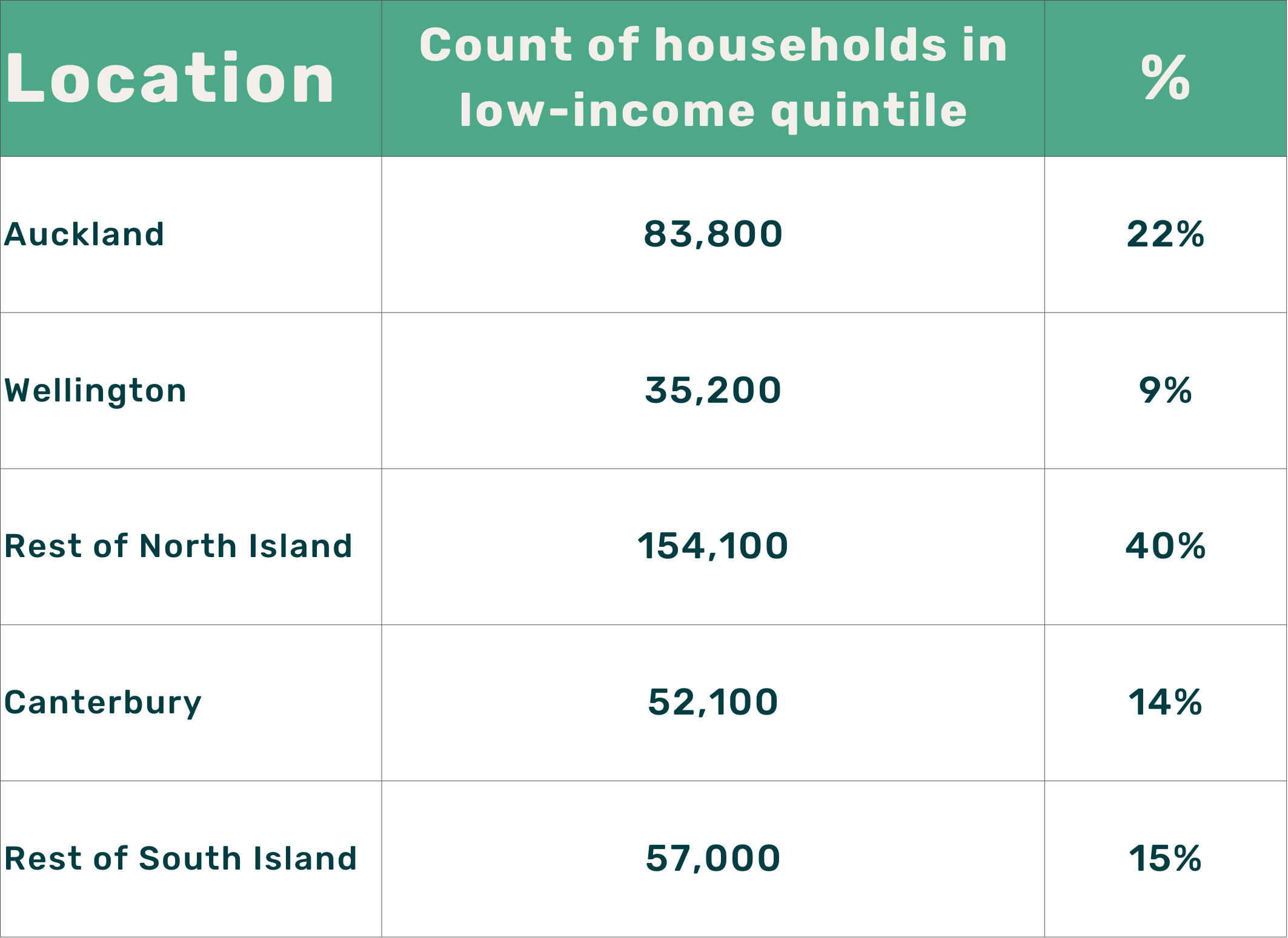
-
As noted earlier in this paper, the work done by FigureNZ shows that all 380 000 households in the lowest income quintile (incomes under $42 200) cannot afford the cost of the basic package, based on the two percent of income threshold. This includes:
58 000 families
240,100 single-person households
78,200 couple-only households
5,900 other household compositions not elsewhere included.
Forty percent of these households reside in North Island regions excluding Auckland and Wellington.
Thirty-five percent of low-income households live in a home that they don’t own, either partially or fully.
Twenty-eight percent of low-income household have at least one person who is disabled.

-
As noted earlier, we think that the starting point for eligibility is income. But other factors could be considered alongside income. Here are some options for eligibility:
Income based. E.g. everyone earning less than a certain amount.
Income based, but only for population groups or regions with lower levels of digital inclusion. For example, Pacific and Māori families, older New Zealanders, families living in social housing, and people with disabilities. This option reduces the number of households receiving support.
Income based, but adjusted for other factors of deprivation and the needs of the household. This would be complex to administer and likely impose a burden on vulnerable New Zealanders to prove their circumstances.
Income based, but only for people who already qualify for or receive existing forms of income support. This approach has been used in the US for its Affordable Connectivity Programme, in the UK for its Social Tariffs initiative, and in Australia for people receiving disability support. This option would make administration of the subsidy easier by tying eligibility to existing entitlements. However, existing entitlements may not match up with the income ranges you choose to support. For example, a family of four earning less than $87 269 would qualify for the Community Services Card.
-
The process for determining, assessing or proving eligibility needs to:
Be simple and noninvasive for the person seeking support. For example, there should not be complicated forms to fill in, lots of evidence to provide, and touch points with multiple organisations.
Avoid having telcos making eligibility decisions or assessments. They are not well placed and do not want to take on this role.
Empower organisations that have experience engaging well with vulnerable people to make the eligibility decisions and decide on the assessment process.
Could involve NGO referring organisations. These community organisations could inform members of their communities about the support on offer and recommend that they receive it. Examples of initiatives using referring organisations include the Australian scheme for internet access through schools, and the most recent phase of the Equitable Digital Access programme here in Aotearoa New Zealand.
-
The answer to the question of who determines eligibility may differ, depending on whether you are considering a digital equity subsidy or funding community initiatives.
For a digital equity subsidy
For a digital equity subsidy we suggest MSD make the eligibility decisions, because it has the experience and the systems.
If the Government doesn’t want to work through MSD, the alternative is to devolve this function to an NGO set up for the purpose, as was done in the US example. The NGO could be the same as the NGO intermediary that is bulk funded to fund digital equity initiatives in the community.
Funding digital equity community initiatives
The suggestion here is that government funding should just be tied to the cohort, leaving it to NGOs to determine eligibility based on their knowledge of the needs in their communities. We discuss this in more detail earlier in this paper on the section on funding for an NGO intermediary.

Part seven: measurement and evaluation
It is important to understand if government interventions and investment to support digital equity is having the intended impact. Measurement and evaluation also helps to shape initiatives that will move us closer to digital equity. Both Australia and the UK have digital inclusion indexes that measure the state of digital inclusion each year, providing a longitudinal picture. New Zealand does not.
-
Part one: an introduction to our affordable connectivity mahi
Part two: the scope and scale of the affordability problem
Part three: introduction to intervention choices for government
Part four: subsidy options for internet and device access
Option A: a digital equity payment through the welfare system - for internet and/or devices
Option B: use an alternative department or an NGO to develop and administer the subsidy
Option C: using and tweaking the existing MSD payment system to subsidise device and internet costs
Option D: subsidising device costs for children through the education system
Part five: getting funding to community programmes through an NGO intermediary
Part six: questions about eligibility and who to focus on
Part seven: measurement and evaluation
-
The Australian Digital Inclusion Index uses data from the Australian Internet Usage Survey, along with data about First Nations people living in remote areas of Australia, to measure digital inclusion across three dimensions of access, affordability and digital ability. The index is a collaboration between the Centre of Excellence for Automated Decision-Making and Society and Telstra.
The UK has a number of measurement tools. These include:
The UK Consumer Digital Index, run by Lloyds Bank. The index benchmarks how the UK is doing in terms of the Essential Digital Skills Framework. The skills part of the survey is commissioned by the UK Department for Education.
Digital inclusion questions in surveys run by the UK Office for National Statistics. These include its Census, Internet Users Labour Force Survey, and the Internet Access Opinions and Lifestyle Survey.
Online Nation, an annual report from Ofcom on the online life of the UK that looks at what people are doing online, how they are served by online content providers and platforms
A Digital Exclusion Risk Index, using indicators of demography, deprivation and broadband access that shows where digital exclusion is most likely to occur.
-
In New Zealand we don’t have an index. What we do have is a sub-optimal census question on internet access, and a digital skills survey (based on the UK index) that has been run by the BNZ a couple of times (kia ora to BNZ).
At the individual initiative level there is guidance from both DIA, the Office of Seniors, and InternetNZ on how to evaluate digital inclusion initiatives.
New Zealand needs to start measuring levels of digital inclusion, at least in terms of internet access, device access and digital skills. We recommend doing this by introducing a digital inclusion index similar to that used in Australia. This could include a partnership with the BNZ on the digital skills side, to continue the work it has started with the digital skills survey, make it an annual thing and expand the sample size.
Appendix one: device needs (and prices) by user type
-
Not included in the pricing below:
Accessories: Carry Bag or peripherals such as mouse, headphones or a display
Insurance
Packages for school-aged children:Chromebook, Carry Case/Bag and 2 Year Insurance
Lenovo equivalent package $450.00-$460.00 HP or Acer equivalent package $560.00-580.00
Costings for family make-up types
Note: Assumptions for multiple child families of both children being in the same schooling categories.Device Only with the cost of the device distributed over 12 months:
-
In New Zealand we don’t have an index. What we do have is a sub-optimal census question on internet access, and a digital skills survey (based on the UK index) that has been run by the BNZ a couple of times (kia ora to BNZ).
At the individual initiative level there is guidance from both DIA, the Office of Seniors, and InternetNZ on how to evaluate digital inclusion initiatives.
New Zealand needs to start measuring levels of digital inclusion, at least in terms of internet access, device access and digital skills. We recommend doing this by introducing a digital inclusion index similar to that used in Australia. This could include a partnership with the BNZ on the digital skills side, to continue the work it has started with the digital skills survey, make it an annual thing and expand the sample size.
Device needs (and pricing options) for individual users.
[1] https://www.broadbandcommission.org/advocacy-targets/2-affordability/
[2] Arataki Systems (AS) is a Māori owned, whānau (family) owned company that build end to end technology solutions. Founded in 2016, Arataki is a tech company based in the Waikato and Bay of Plenty regions of New Zealand, wholly owned and run by Māori tech entrepreneurs. It’s CEO & Founder, Lee Timutimu, has worked in the IT industry for 20+ years. He has deep networks and relationships into the Māori tech ecosystem and public and private sectors. Lee is the Founder of Te Matarau (the Māori Tech Association), Co-Founder of Te Hapori Matihiko (a community for all Māori working in digitech) and Co-Founder of Ko Maui Hangarau (a Rangatahi tech summit). His responsibilities as a leader and advocate for Māori tech sees him participate at all levels within the Māori tech ecosystem, from working on the ground delivering digital literacy workshops to Marae trustees, to inspiring the next generation of Rangatahi Māori into digitech, to sitting at governance tables that have influence. Lee is considered to be a leading voice for Māori in tech.
[3] The Fund is the US version of the New Zealand Telecommunications Development Levy -except that it is more focused on digital equity.(See section 72D - 72I. The way it works is that the Secretary of State directs Ofcom to do a review of affordability for individuals on low incomes or with special needs. The report back may recommend the setting of social tariff conditions. Consultation is required on proposed tariffs. The Secretary of State then issues a direction. Under 72G Ofcom may review the financial burden on particular providers of complying with social tariff conditions. Under 72H Ofcom may determine its fair for other providers to make contributions and share the cost burden.)
[4] Whānau Ora Commissioning Agency (also called Te Pou Matakana) works with whānau and families in the North Island.
[5] Te Pūtahitanga o Te Waipounamu works with whānau and families in the South Island. This is a collaboration between 9 iwi.
[6] Pasifika Futures is dedicated to working with Pacific families across the country. In the end the funding was given to one organisation to spend on its programmes with a partner organisation.
Additional Resources
-
Building young people’s resilience through media and information literacy and digital citizenship skills report. This report was commissioned by PM Ardern and is part of a series of workstreams across government tackling the challenge of mis-, dis- and malinformation. Find out more…
-
In this report, we consolidate and expand on what we know about the nature of digital inclusion in Aotearoa New Zealand. We identify the benefits of increased digital inclusion as well as the key characteristics of promising interventions to address digital under-inclusion. We also explore a continuum of potential investment, identifying three intervention scenarios and, where possible, assessing their costs and benefits. Find out more…
-
LGNZ report with FrankAdvice that unpacked the findings of a survey of 39 public libraries in New Zealand and provided insights into how libraries are evolving their services to enhance community wellbeing in Aotearoa and around the world. Includes digital literacy services. Find out more…
-
Statement of intent around enabling more people in NZ to benefit from connectivity. Find out more…
-
Evaluation of New Zealand's Equitable Digital Access Programme providing internet access to families with school aged children. Find out more…
-
The Strategy is a call to action for the public service to operate in the digital world in a more modern and efficient way — delivering the outcomes that Aotearoa New Zealand needs. Find out more…
-
The NZ Library Association submission on the Local Government Review making a strong case for central government funding to support libraries deliver digital equity. Find out more…
-
Guidance on how to evaluate digital inclusion initiatives in New Zealand. Find out more…
-
Government guidance on how to evaluate digital inclusion initiatives using good practice. Find out more…